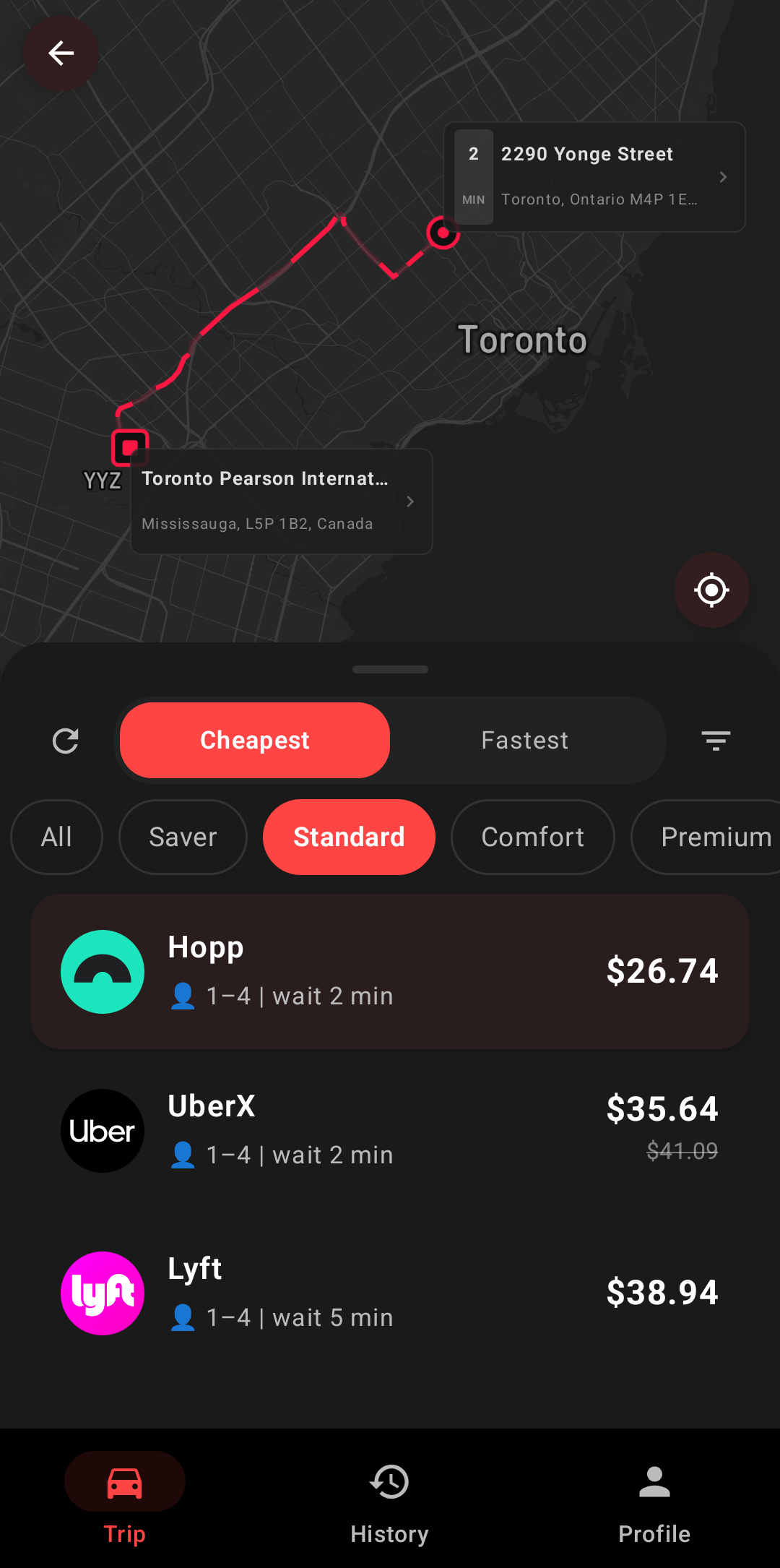
The Cheapest Ride App? It Depends — Here's How to Always Get the Best Price
The 'cheapest ride app' question has no single answer — and that's exactly why aggregators exist.


Key facts
- • No single ride app is cheapest on every ride — the winner changes by route, time, and city
- • The reliable way to always pay less is to compare every provider on every ride
- • Payfair compares 16 apps in real time and sorts them cheapest first
- • Local taxi apps often beat Uber in Europe, Spain, Latin America, and the Nordics
Why 'cheapest ride app' is the wrong question
People search for "cheapest ride app" expecting a single answer — but there isn't one. On one ride, Bolt beats Uber by a wide margin. On the next ride across the same city, Uber is cheapest and Bolt has surge. A week later, a licensed taxi via FREE NOW is cheaper than both. The "cheapest" title changes ride by ride because each provider uses different pricing rules, and those rules interact with local demand, time, weather, and events. The right question isn't "which app is cheapest" — it's "how do I always get the cheapest ride without checking 16 apps manually?"
Provider tendencies (what usually wins where)
While no provider is always cheapest, each has patterns where they tend to win. Uber's global coverage makes it the only option in many markets. Lyft frequently undercuts Uber in mid-size US cities and offers Wait & Save for non-urgent rides. Bolt is often cheapest in European cities and across Africa, especially outside peak hours. Cabify's fixed pricing wins during surge in Spain and Latin America. FREE NOW and taxi.eu win for regulated taxi rates in Europe. Cabonline is the go-to for Nordic cities. Arro and Curb beat surge-priced ride-hailing for NYC and US metros. Yango dominates in Eastern Europe and parts of MENA. These are tendencies, not rules — always compare.
The aggregator approach
Since no single app is always cheapest, the only reliable way to pay less is to compare them all on every ride. Doing that manually means installing 16 apps, creating 16 accounts, and checking 16 prices for every trip — completely impractical. Aggregators solve this: one app, one interface, all 16 prices at once. Payfair is the first ride-hailing aggregator to do this, fetching real-time prices from every provider in parallel and sorting by price. You always see the cheapest ride for each specific trip, without the manual comparison overhead.
Example scenarios
To illustrate how the cheapest option changes: imagine a ride in central London on a Tuesday at 2pm. Uber, Bolt, FREE NOW, and taxi.eu all serve this route, each with different prices. On a quiet weekday afternoon, Bolt or Uber typically win with low base fares. On Friday evening with surge, FREE NOW's regulated taxi meter often wins because it doesn't surge. At 2am after bars close, taxi.eu stays flat while ride-hailing fares can double. These are illustrative scenarios — actual prices vary by city, route, and time. The point: the winner changes based on time and surge conditions, not on any inherent cheapness of a single provider. That's exactly what aggregators are built for.
Compare ride apps






Related guides
Frequently asked questions
Compare & book rides from your phone
The Payfair app compares real-time prices from 16+ services and lets you book the cheapest — all in one place.